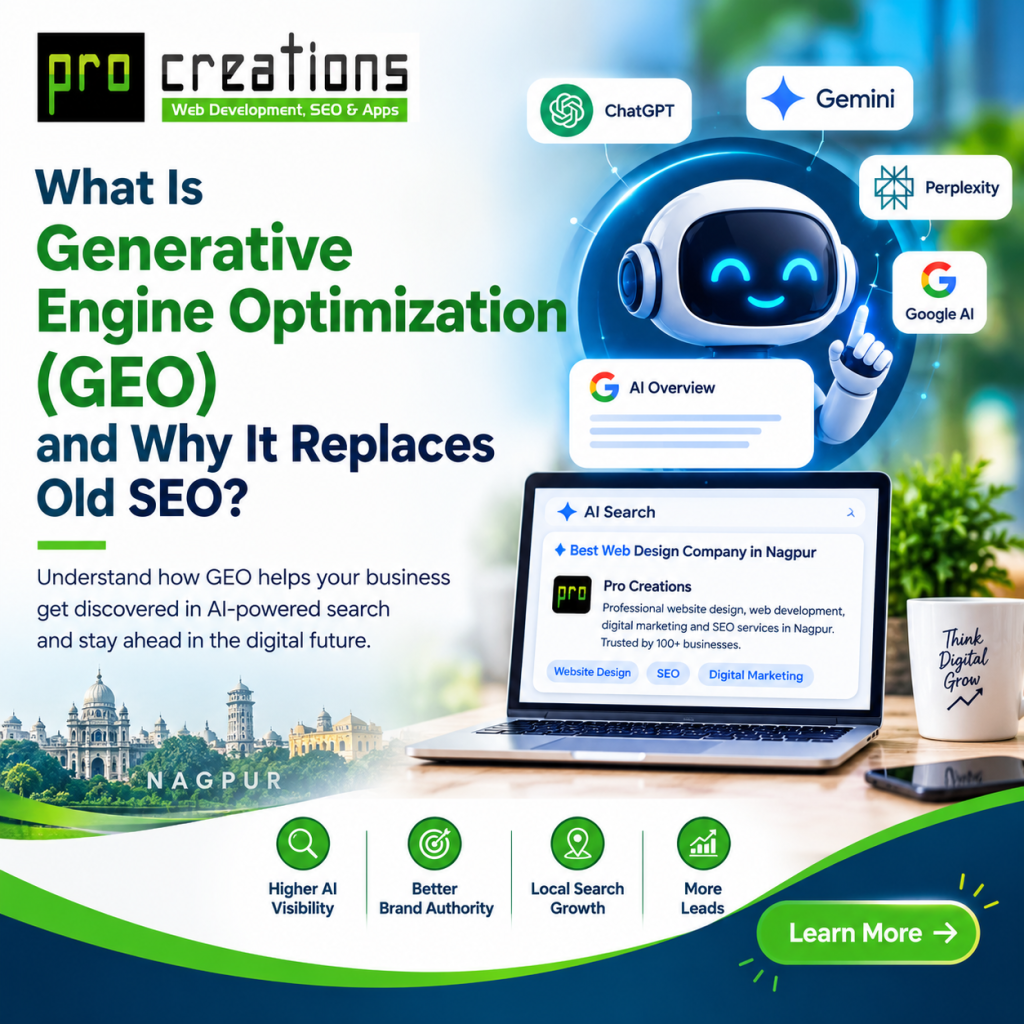

Generative Engine Optimization (GEO) is the practice of optimizing your website, brand, content, and online presence so AI-powered search systems can understand, trust, cite, and recommend your business in generated answers. GEO builds on traditional SEO, but focuses on visibility across AI Overviews, ChatGPT, Gemini, Perplexity and other generative search experiences.
What Is Generative Engine Optimization (GEO)?
Generative Engine Optimization, commonly called GEO, is an emerging digital marketing approach designed for the way people increasingly search with artificial intelligence.
Traditional SEO primarily focused on helping a webpage appear prominently in a list of search results. GEO focuses on a different question:
Can an AI system understand your business well enough to include it in the answer?
Generative search systems can combine information from multiple sources and produce a direct response instead of simply displaying ten blue links. The original academic research that introduced the GEO concept described this shift toward generative engines that synthesize information from multiple sources.
Today, AI-driven search experiences include platforms and features such as:
- Google AI Overviews
- Google AI Mode
- ChatGPT search
- Microsoft Copilot
- Google Gemini
- Perplexity
- Other AI-powered discovery platforms
This means businesses need to think beyond ranking a page. They also need to build a digital presence that AI systems can understand and use as a trustworthy source.
Is GEO Replacing Traditional SEO?
Not literally. GEO is better understood as the next layer of SEO rather than a complete replacement for SEO.
Google’s current documentation specifically says that its existing SEO best practices continue to be relevant for AI Overviews and AI Mode. Google has also published dedicated guidance on optimizing for generative AI features in Search.
The important change is the search experience.
Old-style search behaviour often looked like:
Keyword → Google → Search results → Website → Contact
AI-assisted search can look more like:
Question → AI search → Synthesized answer → Sources/brands → Website/contact
Therefore, businesses should continue investing in:
- Technical SEO
- Website performance
- Search intent
- Quality content
- Internal linking
- Structured data
- Local SEO
- Backlinks and digital authority
But they should also add:
- Entity optimization
- Conversational content
- Question-based content
- Clear factual statements
- First-hand expertise
- Author and business credibility
- Multi-platform brand visibility
- AI search monitoring
That combined approach is much more practical than treating GEO and SEO as competing strategies.
How Does GEO Work?
How Do AI Search Engines Understand a Business?
AI systems need enough reliable information to understand who you are, what you do, where you operate, and why your information should be trusted.
For example, imagine a person asks:
“Who provides professional website design services in Nagpur?”
A traditional SEO strategy might target the keyword website design company in Nagpur and attempt to rank a service page.
A GEO strategy goes further.
Your online presence should clearly establish:
- Business name
- Location
- Services
- Areas served
- Industry expertise
- Experience
- Customer problems solved
- Supporting content
- Reviews and reputation
- Relevant third-party mentions
- Consistent business information
The objective is to create a strong and understandable digital entity around the business.
Why Is GEO Important for Businesses in 2026?
Search is becoming increasingly conversational.
People no longer always search using short phrases such as:
They may ask:
“Which company can build an affordable SEO-friendly website for a small business in Nagpur?”
Or:
“What should I look for before hiring a web development company in Nagpur?”
Or:
“Which digital marketing agency can help a local business generate leads from Google?”
These are longer, contextual questions.
GEO helps businesses create content that directly addresses these real-world questions.
Google itself now provides documentation specifically covering AI features in Search, including AI Overviews and AI Mode.
What Is the Difference Between GEO and SEO?
Traditional SEO is heavily concerned with search visibility and rankings.
GEO is concerned with visibility inside AI-generated answers.
For example, traditional SEO may focus on:
- Keyword targeting
- Page rankings
- Technical SEO
- Backlinks
- Search traffic
- Click-through rate
GEO adds another layer:
- AI citations
- Brand mentions
- Entity recognition
- Source selection
- Answer visibility
- Conversational queries
- Content extraction
- Brand authority across multiple sources
This does not mean keywords have suddenly become useless.
Instead, keywords become part of a larger semantic and entity-based strategy.
Google’s documentation also emphasizes that structured data can help Google understand webpage content, reinforcing the importance of machine-readable information alongside human-friendly content.
What Are the Main GEO Strategies?
1. Create Direct Answers to Real Questions
Instead of writing content only around a keyword, create sections that answer the questions your customers actually ask.
For example, a Nagpur web agency could create content around:
- What does a business website cost in Nagpur?
- How long does website development take?
- Is WordPress suitable for small businesses?
- How can a website generate leads?
- What is SEO-ready website design?
- How can local businesses appear on Google?
- What is GEO in digital marketing?
Each section should provide a clear answer before expanding into supporting information.
2. Build Strong Business Entities
AI systems need context.
A company should consistently communicate:
Who → What → Where → For whom → Why trust us
For Pro Creations, for example, relevant entity information includes:
- Pro Creations
- Web design
- Web development
- Digital marketing
- SEO
- AI search optimization
- Lead generation
- Nagpur
- Maharashtra
- Local businesses
The same core information should remain consistent across the website, Google Business Profile, social profiles, business directories and other credible online sources.
3. Publish Experience-Based Content
AI search optimization is not simply about generating hundreds of generic articles.
Content should demonstrate genuine expertise.
Strong content can include:
- Original research
- Practical examples
- Case studies
- Industry experience
- First-hand observations
- Expert explanations
- Local market insights
- Original images and videos
- Clearly attributed data
This is particularly important for competitive commercial searches.
4. Make Content Easy for AI to Understand
Good GEO content should be clear, structured and extractable.
Use:
- Descriptive H2 and H3 headings
- Short paragraphs
- Bullet points
- Definitions
- Step-by-step explanations
- Specific examples
- Question-based headings
- Relevant internal links
- Structured data where appropriate
A page should not force an AI system to interpret a huge wall of text before discovering the answer.
5. Strengthen Brand Authority Beyond Your Website
Your website is important, but it is not the only source of information about your business.
AI search can encounter information from multiple places.
A strong GEO strategy can therefore include:
- Google Business Profile
- Industry directories
- Reviews
- YouTube
- Social media
- News and publications
- Expert interviews
- Business listings
- Partner websites
- Relevant third-party websites
Recent GEO research also highlights the importance of third-party and earned-media signals in AI search visibility.
How Can a Local Business Use GEO?
Local GEO is particularly relevant for businesses that depend on customers from a specific city.
Consider a Nagpur-based clinic, school, restaurant, manufacturer, consultant or service company.
Instead of targeting only:
a local GEO strategy can address questions such as:
- Which digital marketing services are useful for Nagpur businesses?
- How can a local business get more Google leads?
- How does Google Maps help local businesses?
- How much does SEO cost in Nagpur?
- What should a small business website include?
- How can a business appear in AI search results?
The goal is to make the business a recognizable local entity associated with its services and location.
For local businesses, GEO should work together with Local SEO and Google Business Profile optimization, rather than replacing them.
How Can GEO Help a Website Generate More Leads?
GEO is not simply about getting mentioned by AI.
The larger business objective is discovery → trust → website visit → enquiry → lead.
For example, a potential customer might ask an AI system:
“How can a small manufacturing company in Nagpur get more enquiries through Google?”
If an AI-generated answer identifies a business as a relevant source or recommendation, the user may investigate that business.
A lead-generation website should then make the next step easy through:
- Clear service pages
- Strong calls to action
- WhatsApp integration
- Contact forms
- Phone numbers
- Local business information
- Case studies
- Reviews
- Trust signals
- Fast mobile experience
GEO therefore works best when combined with conversion-focused website design.
What Should Businesses Do to Prepare for AI Search?
A practical GEO strategy can begin with these steps:
- Audit your existing SEO.
- Identify the questions customers ask before buying.
- Create dedicated pages answering those questions.
- Strengthen your business and service entities.
- Add relevant structured data.
- Improve author, business and source credibility.
- Build consistent local business information.
- Create useful video and visual content.
- Earn credible third-party mentions and links.
- Monitor how AI systems describe and mention your brand.
Do not abandon technical SEO while doing this. Google continues to emphasize crawlability, indexability and established SEO practices for its AI search experiences.
Is GEO Useful for Small Businesses?
Yes, but the strategy should be realistic.
A small business does not need thousands of pages.
It needs high-quality, highly relevant information around its services, customers, location and expertise.
For example, a Nagpur business could build a focused content ecosystem around:
- Main service pages
- Location pages
- Problem-based pages
- Customer questions
- Industry-specific pages
- Case studies
- Expert articles
- Videos
- Google Business Profile content
This can create a stronger digital footprint than publishing large quantities of generic AI-generated content.
Google’s current guidance also emphasizes useful, original content and warns against using generative AI in ways that violate its spam policies.
What Does the Future of SEO Look Like?
The future is unlikely to be simply SEO versus GEO.
Instead, successful search marketing will combine:
SEO + Local SEO + AEO + GEO + Entity SEO + Content + Digital PR + Conversion Optimization
The biggest change is that search visibility is becoming broader.
A business may need to be:
- Found by search engines
- Understood as an entity
- Referenced by authoritative sources
- Included in AI-generated answers
- Trusted by potential customers
- Easy to contact
That is why businesses should start thinking about AI search visibility, not only traditional keyword rankings.
At Pro Creations, we help businesses build websites and digital marketing strategies designed for Google Search, local discovery, AI search and lead generation.
Want to know whether your website is ready for AI search and GEO? Contact Pro Creations, Nagpur, for a free consultation.
Pro Creations
439/A, Hanuman Nagar, Nagpur
Phone: +91 9021651741, 8007779851
Website: www.procreations.in
Google Maps: https://maps.app.goo.gl/ojFSXYQVKcBTCRKr6
Frequently Asked Questions – What Is Generative Engine Optimization (GEO) and Why It Replaces Old SEO
1. What is Generative Engine Optimization (GEO)?
Generative Engine Optimization (GEO) is the process of optimizing a website and online presence so AI-powered search systems can understand, reference, cite, and recommend a business or its content in AI-generated answers.
2. Is GEO replacing traditional SEO?
GEO is not a complete replacement for traditional SEO. It expands SEO for AI-powered search experiences such as Google AI Overviews, AI Mode, ChatGPT, Gemini, and Perplexity.
3. What is the difference between GEO and SEO?
SEO focuses mainly on improving visibility and rankings in traditional search results, while GEO focuses on making content understandable, trustworthy, and potentially referenceable in AI-generated search responses.
4. Why is GEO important for businesses in 2026?
As people increasingly use conversational AI and AI-powered search to find information, businesses need to optimize their digital presence for both traditional search engines and generative search experiences.
5. How does Generative Engine Optimization work?
GEO uses strategies such as clear question-based content, strong business entities, structured information, topical authority, first-hand expertise, relevant links, and consistent information across trusted online sources.
6. Does GEO improve Google rankings?
GEO does not guarantee higher Google rankings. However, many GEO practices overlap with established SEO principles, including useful content, clear site structure, strong expertise, and technically accessible webpages.
7. Can GEO help a local business appear in AI search results?
Yes. Local businesses can use GEO alongside Local SEO by building consistent business information, location-specific content, service pages, reviews, and authoritative online references.
8. What is AI Search Optimization?
AI Search Optimization is the broader practice of preparing a website and brand for visibility across AI-powered search systems and answer-generation platforms.
9. What type of content is best for GEO?
Content that directly answers customer questions, demonstrates genuine expertise, provides useful examples, uses clear headings, and contains accurate and well-supported information is generally suitable for GEO.
10. Is keyword research still important for GEO?
Yes. Keyword research remains useful because it helps identify the topics, questions, and search intent of your target audience. GEO adds conversational questions and broader topic relationships to traditional keyword targeting.
11. What is Entity SEO and why is it important for GEO?
Entity SEO helps search engines and AI systems understand businesses, people, products, services, locations, and their relationships. A clearly established business entity can make a website’s information easier for search systems to interpret.
12. Can small businesses use GEO?
Yes. Small businesses can start with focused service pages, location pages, customer questions, expert content, Google Business Profile optimization, reviews, and consistent business information across relevant platforms.
13. How can a Nagpur business use GEO?
A Nagpur business can create locally relevant content around its services, customer problems, industries, and locations while maintaining consistent business information and combining GEO with Local SEO and Google Business Profile optimization.
14. How long does GEO take to show results?
There is no fixed timeframe for GEO results. Visibility depends on factors such as website quality, competition, authority, content depth, technical SEO, brand recognition, and how frequently AI and search systems update their information.
15. Should businesses use SEO, AEO, and GEO together?
Yes. A comprehensive search strategy can combine traditional SEO, Answer Engine Optimization (AEO), Generative Engine Optimization (GEO), Local SEO, Entity SEO, quality content, and conversion optimization to reach users across different search experiences.